How to Take Water Samples for Legionella Testing
 Collecting water samples correctly is a crucial step in testing for Legionella bacteria, which can pose serious health risks if left undetected. Proper sampling ensures that laboratory analysis accurately reflects the presence or absence of contamination in water systems, enabling effective risk management and compliance with relevant safety standards. Whether you’re conducting routine monitoring or investigating a suspected outbreak, following the correct sampling procedures is essential for reliable results.
This article provides step-by-step guidance on how to take water samples for Legionella testing. It outlines the necessary equipment, explains where and when to collect samples, and describes best practices for handling and transporting them to a laboratory. By following these instructions, duty holders and water safety professionals can ensure accurate testing and contribute to the ongoing control and prevention of Legionella in water systems.
A version of this article outlining the correct procedures for taking water samples for legionella testing appeared in Legionella Control International’s newsletter. To get it in your inbox, sign up for free here.
Why take water samples and test for Legionella?
If you are responsible for managing and maintaining the safety of a water system, you should know that taking water samples for Legionella testing can be an essential part of the risk management process. Each water system must be risk assessed for safety, so appropriate measures can be taken to reduce the risks posed by Legionella bacteria.
Testing water samples is, therefore, a good way to make sure all relevant measures are working as they should. It can also provide crucial information should an outbreak of Legionnaires’ disease occur. Of course, regular monitoring, maintenance, and testing should all combine to ensure that the risk of an outbreak is kept as low as possible.
Sampling techniques for Legionella
This short film (7.17 mins) provides a useful summary of the procedures used when taking water samples for Legionella testing. It provides basic guidance for sampling taps and showers, dip and swab samples, and explains how to send samples to the lab.
Safety precautions when sampling water systems
Regardless of the reason for collecting water samples for Legionella testing, you must always do so in a safe manner. Before taking any samples, make sure you read through the existing Legionella risk assessment for the water system in question.
There should be a record of how the system is being treated via thermal disinfection or biocide dosing, how often, and when the water was last sampled. This information should also include details of when and how the water samples were collected and sent for testing.
All this information will help you approach the Legionella testing process with accuracy. If it’s not done properly, the results can’t be relied upon. Remember too that you must consider your own safety when preparing to take samples.
For example, if a sample is less than one litre in size, it won’t be suitable for testing under current procedures. You should also follow the correct transport and storage instructions to ensure the water sample doesn’t undergo any changes on its way to the lab for testing. This could potentially lead to an incorrect result that does not reflect the condition of the water in the system.
What equipment is needed when sampling for Legionella?
Public Health England provides a list of items you must have with you to be able to complete the Legionella sampling process. Of course, you should also possess knowledge of how to conduct the testing via appropriate training. You may also require other items to keep yourself safe, depending on the location; this may include personal protective equipment (PPE).
A good example of maintaining personal safety comes when sampling water from a shower head. By design, a shower head creates a spray (an aerosol), and so if there are any Legionella bacteria inside the shower head or hose, you may be at risk from inhaling contaminated water droplets when taking the water sample.
For safety purposes, you’d typically remove the shower head and take your water sample from the hose in this instance. If you can’t take off the shower head, use a food safe plastic bag attached over the top of the shower to limit the creation of an aerosol, cut a small hole in the bag that will allow it to funnel the water into your one-litre collection bottle.
Typically, equipment you may need to carry out water sampling for Legionella can include the following:
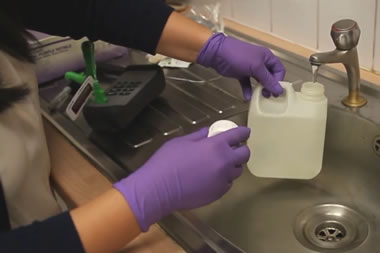
- One litre sample bottles. These should contain sodium thiosulphate which will neutralise oxidising biocides in the water such as chlorine.
- Something to disinfect the sample points, such as disinfecting wipes.
- Labels and something to record details of the sample taken.
- A calibrated thermometer, with immersion or surface probes.
- Disposable gloves
- Torch.
- Suitable transportation containers and packing materials for the sample bottles.
- Clean, food grade plastic bags, scissors and elastic bands for sampling of showers.
- Personal protective equipment, as identified by the risk assessment.
- You may also require specialist equipment such as sterile swabs with storage medium for sampling surfaces and sterile dip samplers.
Sampling other water assets for Legionella
Another crucial factor involved in the Legionella sampling process covers the outlets or water sources you are going to test. The legionella risk assessment should highlight the areas that pose the greatest risk for Legionella bacteria to thrive and better establish themselves. It is these areas that must be tested to determine whether the bacteria have taken hold or whether the maintenance and water treatment protocols are indeed working.
The process for taking samples can vary depending on where you are testing. For example, taking samples from taps is best done via either a hot or cold tap as relevant. Mixer taps take water from both the hot and cold water sources, and so it can be more difficult to determine where any contaminants are coming from.
Should you take pre or post-flush water samples?
You should also consider whether you require a pre-flush sample or a post-flush sample. Pre-flush samples take water straight from the outlet, whereas post-flush samples allow for running the water first to flush through the pipes and the outlet. Be sure you follow the instructions for pre- or post-flush collection of samples as appropriate. If anything is missed, you could end up with a contaminated or incorrectly taken sample.
Water sampling investigations after Legionnaires’ disease
It’s important to note that there is a different approach taken when gathering water samples following a suspected outbreak of Legionnaires’ disease, compared to following up once control has been regained over the safety of the water system.
If an outbreak of Legionnaires’ disease is suspected, pre-flush samples would always be taken to determine the level of bacteria coming from that outlet. Once investigations are completed, you would switch to taking post-flush samples.
Alternative approaches to sampling for Legionella
Of course, taking water directly from outlets such as taps and showers isn’t suitable for all scenarios. When you are faced with other water assets within the system, such as water storage tanks, cooling towers, and other bodies of water, another approach is often required. In such cases, a dip or swab sample may be the better option.
Dip sampling for Legionella
For dip samples you’ll need to take the collection sample bottle and dip it into the water source in this instance, so it is imperative to follow instructions designed to guide you when taking dip samples. Each sample area should be treated as an individual site. This means proper preparation, including disinfecting your hands (or wearing a fresh set of gloves), in each case is required.
Swab sampling for Legionella
Another way to test the water for Legionella is to use a swab sample. This method allows you to collect biofilm from the sides of a water storage tank or similar storage unit, something you cannot do with a water sample alone. It’s important not to simply swipe the swab along the surface though – make sure you twist it so that every part of the swab touches the area to be tested.
How to transport water samples to the lab?
When all relevant water samples have been collected and the information recorded, you must follow the guidelines for transporting the samples to be tested in the lab. The collection bottles should have clear labelling on the sides to be filled in as appropriate. This provides a clear record of the date and time of collection, the site and location the sample was taken from, whether it was hot or cold, water temperature etc.
You should have a transport box in which to safely pack all your water samples, and the lab should be able to receive and start testing them within 24 hours of being collected. It is essential that you always make sure you use an accredited lab, registered with UKAS for Legionella analysis. The exception to this is when samples are taken during a suspected outbreak of Legionnaires’ disease. In such scenarios samples should always go to the dedicated labs that form part of Public Health England (PHE) or your local health regulator depending on location.
Legionella sampling and testing expertise
You can see that anyone involved in the Legionella sampling and testing process should possess proper knowledge and experience of such procedures. If you are responsible for water safety, you can enlist the services of an expert from an external company, and that’s something Legionella Control International can help with. Knowing that all required water samples are taken properly, from the appropriate places and at the correct times will help you maintain the overall safety of the water system you are responsible for. Even when you have a basic understanding of the required processes to follow, you may still not have the expertise needed to do it properly.
Leading Legionella and water safety specialists
Legionella Control International are experienced Legionella and water safety specialists supporting those responsible for the control of waterborne pathogens including Legionella in the workplace. We help businesses protect their workers, customers and others from the dangers caused by water systems, helping them to meet their health and safety compliance obligations in this specialist area.
We are experienced in all aspects of Legionella and water safety and deliver a full range of services including Legionella sampling and water safety risk assessments. We also offer compliance auditing, water quality testing, City & Guilds training and other health and safety risk management services that help keep staff and others safe.
If you would like to speak with one of our Legionella specialists about sampling your water systems for legionella call us today on 0330 223 36 86 or contact us here …

