• Online training login
t: 0330 223 36 86     e: [email protected]
Legionella Control International
  • Home
  • Services
  • Knowledge
  • Legionnaires
  • About
  • Contact
  • Click to open the search input field Click to open the search input field Search
  • Menu Menu
You are here: / Home / Knowledge / Guidance / Removing Dead Legs from Hot & Cold Water Pipes

Removing Dead Legs from Hot & Cold Water Pipes to Prevent Legionella
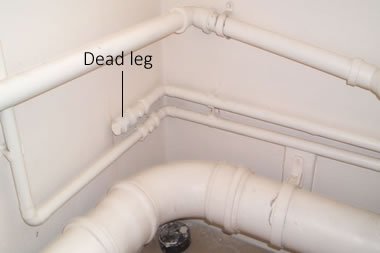
Removing Dead Legs from Hot & Cold Water Pipes

Dead legs may sound like something you get after sitting for too long, but when they are found in water systems they can present a significant risk to people as they encourage the stagnation of water and the growth of potentially dangerous bacteria such as legionella.

The term dead leg, or dead end is typically used to describe a run of pipework that is no longer in use or a pipe that has become isolated from the regular flow of water.

The term can also refer to a run of pipework that is only used very occasionally. In such instances, this lack of use can lead to water stagnation and increase the risk that the water inside the pipe becomes contaminated with potentially dangerous bacteria, including legionella.

This contamination can lead to problems within the rest of the water system and should be avoided.

  • Learn more about Legionnaires’ disease here

Is removing dead legs from your water pipes a good idea?

If you know a length of pipework forming part of your hot or cold water distribution system is never used, or has become isolated then steps should be taken to remove it entirely, rather than simply capping it off.

Capping it will simply lead to stagnant water collecting inside the pipe.

This in turn leads to a greater chance for bacteria to multiply in that water, including the Legionella bacterium.

  • DIY legionella test – no prior experience, simple, easy to use with results in 25 minutes

This can in-turn lead to Legionnaires’ disease and Pontiac fever, a less harmful yet still problematic condition stemming from legionella bacterial contamination.

… as a rule of thumb the maximum size of a dead pipe or dead leg should be no longer than 1.5 x its width

As a rule of thumb, and according to guidelines, the maximum size of a dead pipe or dead leg should be no longer than 1.5 x its width.

If you are unsure about removing dead legs safely and to ensure they are done properly, you can hire an expert familiar in dealing with such pipework.

  • Why you should always start with a legionella risk assessment

What if the water pipe is used only occasionally and cannot therefore be removed?

While this scenario is not ideal, if it cannot be avoided you should consider how you can make the dead leg less dangerous if it needs to be retained within the water system.

The most obvious way to do this is to flush the pipes through periodically.

This makes it harder for any bacteria to remain, and ensures the system is safer than it would otherwise be.

  • Should you test your water for Legionella bacteria?

Review your legionella risk assessment

If you are the designated responsible person, responsible for the upkeep of a hot or cold water system, you should have a legionella risk assessment and risk management procedures in place.

This report should account for all dead legs in the system.

Those that cannot be removed under the conditions stated above should be regularly reviewed to ensure the proper steps are taken to reduce risk factors.

Proper treatment of the hot and cold system will also reduce the risk.

  • Expert guidance on the legionella risk assessment process

It is also recommended that you consider hiring an expert company like Legionella Control International to carry out a full legionella risk assessment of your water systems, to ensure nothing is missed.

Only a fully-trained specialist will understand the complexities of the system to ensure the dangers of legionella and other bacteria are properly considered.

  • Learn more about our City & Guilds accredited legionella training courses

Legionella and water safety specialists

Our teams of water safety specialists support those responsible for the control of waterborne pathogens including Legionella bacteria across all regions of the UK and internationally.

We deliver professional water safety solutions, water testing, independent compliance auditing, City & Guilds training and other environmental risk management services that help keep people safe.

If you have questions about any of the issues raised above or you would like to speak with one of our legionella specialists please call us today on 0330 223 36 87 or contact us here.

Search Search

Expert resources…

  • Legionella & other pathogens
  • Regulatory compliance
  • Expert guidance
  • International
  • Legionnaires’ disease
  • Legionella training
  • Glossary of terms
  • FAQ
  • News

REVIEWS

4.8
Legionella Control International is rated 4.8 out of 5 stars (based on 182 customer reviews)
Read our reviews

Get in touch...

Legionella Control International
Warren Bruce Court
Warren Bruce Road
Manchester M17 1LB
United Kingdom

Manchester: +44 (0) 161 877 05 86
London: +44 (0) 203 637 47 48
Email: [email protected]

Legionella newsletter...

A simple and convenient way of keeping up to date with the latest Legionella news, new legislation, best practice, R&D and much more…

Useful downloads…

  • HSE ACOP L8 – Control of Legionella
  • HSG274 Part 1 – Evaporative Cooling
  • HSG274 Part 2 – Hot & Cold
  • HSG274 Part 3 – Other Risks
  • Positive Legionella Tests – What To Do?
  • HSG282 – Spa Pools
  • Legionnaires’ – Duty Holders Guide
  • Health & Safety – Care Homes
  • Scalding Risks – Health & Social Care
            © Copyright 2026 - Legionella Control International Ltd.
  • Link to X
  • Link to Facebook
  • Link to LinkedIn
  • Home
  • About
  • Contact
  • FAQ
  • Disclaimer
  • Privacy
  • Modern Slavery
  • Reviews
  • Sitemap
Link to: BUPA care home fined £3m after Legionnaires death Link to: BUPA care home fined £3m after Legionnaires death BUPA care home fined £3m after Legionnaires deathBUPA care home fined £3m after Legionnaires’ death Link to: Pontiac Fever: The Lesser-Known Relative of Legionnaires’ Disease Link to: Pontiac Fever: The Lesser-Known Relative of Legionnaires’ Disease Pontiac Fever & Legionnaires’ DiseasePontiac Fever: The Lesser-Known Relative of Legionnaires’ Disease
Scroll to top Scroll to top Scroll to top

This site uses cookies. By continuing to browse the site, you are agreeing to our use of cookies.

OKLearn more

Cookie and Privacy Settings


How we use cookies

We may request cookies to be set on your device. We use cookies to let us know when you visit our websites, how you interact with us, to enrich your user experience, and to customize your relationship with our website.

Click on the different category headings to find out more. You can also change some of your preferences. Note that blocking some types of cookies may impact your experience on our websites and the services we are able to offer.

Essential Website Cookies

These cookies are strictly necessary to provide you with services available through our website and to use some of its features.

Because these cookies are strictly necessary to deliver the website, refusing them will have impact how our site functions. You always can block or delete cookies by changing your browser settings and force blocking all cookies on this website. But this will always prompt you to accept/refuse cookies when revisiting our site.

We fully respect if you want to refuse cookies but to avoid asking you again and again kindly allow us to store a cookie for that. You are free to opt out any time or opt in for other cookies to get a better experience. If you refuse cookies we will remove all set cookies in our domain.

We provide you with a list of stored cookies on your computer in our domain so you can check what we stored. Due to security reasons we are not able to show or modify cookies from other domains. You can check these in your browser security settings.

Google Analytics Cookies

These cookies collect information that is used either in aggregate form to help us understand how our website is being used or how effective our marketing campaigns are, or to help us customize our website and application for you in order to enhance your experience.

If you do not want that we track your visit to our site you can disable tracking in your browser here:

Other external services

We also use different external services like Google Webfonts, Google Maps, and external Video providers. Since these providers may collect personal data like your IP address we allow you to block them here. Please be aware that this might heavily reduce the functionality and appearance of our site. Changes will take effect once you reload the page.

Google Webfont Settings:

Google Map Settings:

Google reCaptcha Settings:

Vimeo and Youtube video embeds:

Other cookies

The following cookies are also needed - You can choose if you want to allow them:

    Download our Legionella Risk Assessment Checklist for business owners, landlords, property managers and health and safety specialists and start managing your legionella risk today.