Continuous Water Quality Monitoring for Legionella: Can It Replace Traditional Water Sampling?
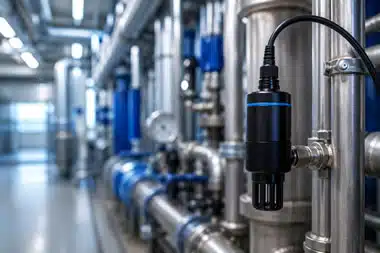
Traditional water sampling has formed the backbone of Legionella risk management for many years, but one of its drawbacks is that it only provides a snap-shot of water quality at the time it’s taken. Advances in sensor technology, the Internet of Things (IoT) and artificial intelligence are now allowing us to monitor water systems continuously, providing real-time information about the conditions that influence Legionella growth. Organisations can now detect changes live, as they happen rather than waiting for routine inspections to identify a problem. This allows them to respond before issues develop into a more significant risk.
In this article, we explain how continuous water quality monitoring works, which parameters can be measured, and where this technology is already being used. We also look at its limitations, ask if it can detect Legionella directly, and how it compliments traditional laboratory testing. We conclude by reviewing why we and many other experts believe continuous monitoring will become an important part of modern water safety management, enhanced by good engineering practice and traditional laboratory analysis.
A version of this article highlighting the use of continuos water quality monitoring and asking if it can replace traditional water sampling first appeared in Legionella Control International’s newsletter. To get it in your inbox, sign up here.
Continuous water quality monitoring for Legionella
Previously, we’ve looked at AI predictive analysis and the role it can play in reducing Legionella risk in water systems. By using water quality sensors to continually monitor the water in all parts of a system, AI models can alert us to issues before they get the chance to develop into something far more serious.
In this article, we’ll look at online water quality analysis. We’ll find out what’s involved and whether this continual testing approach may eventually replace traditional water sampling in various parts of a hot and cold-water system.
Continuos monitoring, coupled with AI can spot problems before they become compliance failures
What is continuous online water quality monitoring?
This is a process that relies on automated sensors to continually measure water quality throughout a water system. By having water sensors in place all the time, AI models can amass current data from across the system and compare it to historical data.
This allows for real-time monitoring using a variety of parameters and tools. It also reduces the chance of any negative effects or issues occurring. If the water sensors identify a potential issue, it can be resolved proactively before it gets the chance to develop into something more serious.
For example, you can use online water quality analysis to monitor bacterial levels in the water for Legionella and other waterborne bacteria. If these rise too much, they can cause the bacteria to spread throughout the system and pose a risk to anyone who may inhale water vapour or spray.
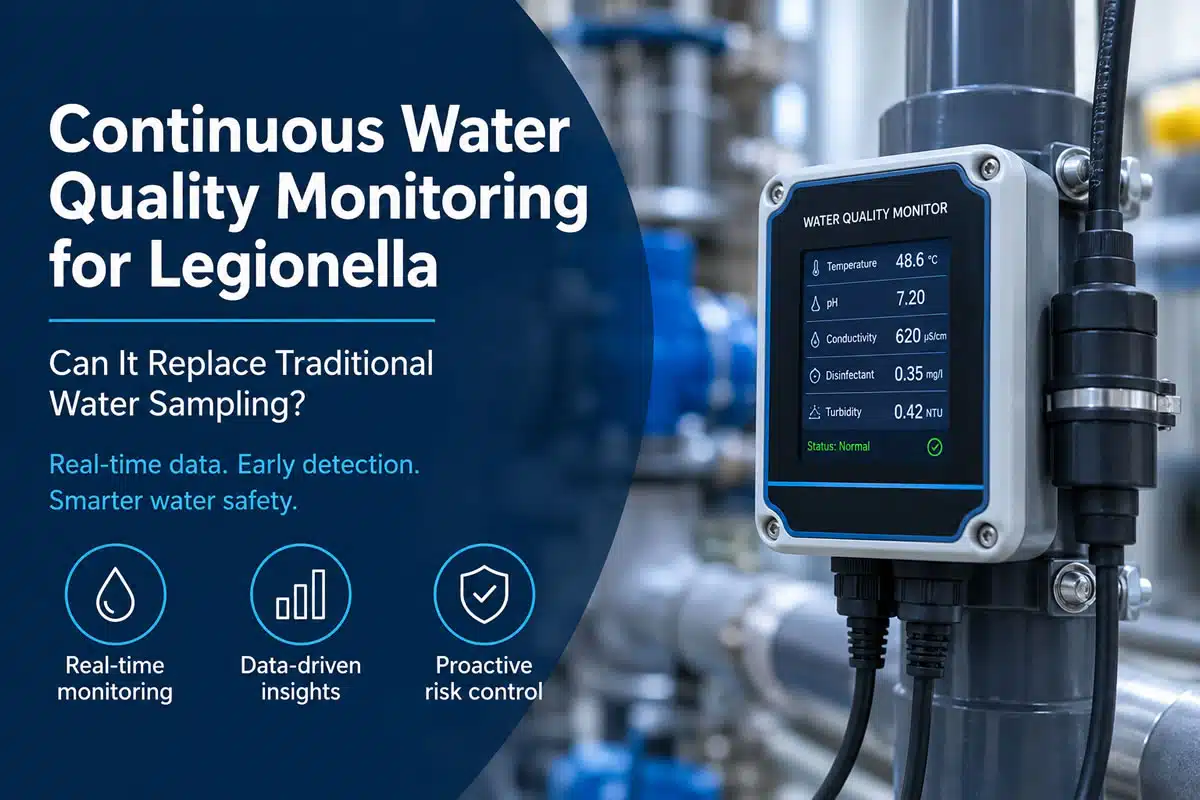
| Continuous water quality monitoring provides real-time insight into changing water conditions, helping organisations identify potential Legionella risks before they become compliance issues.
Which water quality parameters can be continuously monitored?
Online water quality analysis can monitor many parameters, including:
- Water temperature
- pH
- Turbidity
- Conductivity
- Turbidity
- Disinfectant residuals
- ORP (Oxidation Reduction Potential)
- Water flow (stagnation)
- Nutrients
By adopting various parameters and identifying safe levels of each component, online analysis can alert you to any changes or rises as soon as they occur. Preventative action can then be taken to reduce those levels.
Why continuous monitoring matters for Legionella risk management
This type of water analysis acts as an early warning system for all the parameters it is designed to monitor. If you’re still performing manual checks and analysis – whether that is for water temperature or other factors – you’ll only have a “snap-shot” of the moment you performed those checks. Continual monitoring means that you can respond whenever you are alerted to an anomaly in the water system. This also prevents serious problems occurring – such as a Legionella contamination issue that could potentially lead to an outbreak of Legionnaires’ disease.
Once the monitoring system is in place, you can also benefit from better efficiency and lower ongoing costs. You won’t need to allocate staff to perform testing or other checks, since they will be continually done by the IoT (Internet of Things) water sensors. Such things cannot be forgotten or overlooked, since they’re always happening courtesy of the online water quality analysis system.
Can continuous monitoring detect Legionella?
Not directly – at least not in the way a traditional laboratory test can.
Most continuous water monitoring systems do not identify Legionella bacteria themselves. Instead, they measure the water conditions that can encourage Legionella to survive and grow. This can include water temperature, disinfectant residuals, pH, turbidity and water flow (or stagnation).
If the data begins to move outside acceptable limits, the monitoring system can alert to prompt further investigations and potential corrective action before conditions deteriorate further.
Where problems are identified, water samples can be taken and sent to a laboratory for analysis to confirm whether Legionella or other bacteria are present. Continuous monitoring complements traditional laboratory testing rather than replacing it. It provides an early warning system that helps organisations respond faster and make better-informed decisions.
Using AI to identify hidden trends in water system performance
One often overlooked benefit involves identifying trends in the water system. AI models can take vast quantities of data from these continual checks and use it to identify even the smallest differences. Such differences could lead to bigger issues in the future. Thus, you can make alterations to your approach to water safety to mitigate those risks.
What are the limitations of continuous monitoring?
The main initial limitation is cost. Once the system is installed, however, it will bring good cost savings, with fewer staff required to manually perform water quality analysis and testing.
You must also make sure you and others involved in water safety have the required expertise and knowledge to use the system. This refers to both operation and maintenance. You can enlist the services of an external specialist company such as Legionella Control International to handle this aspect for you, as you would if you wanted us to handle manual water testing.
Finally, water quality analysis isn’t ideal if you require something temporary rather than permanent. Once installed, IoT water sensors will remain in place and cannot easily be moved. If you are planning changes to the water system in future – for example, a new building on site requiring an extension of the current water system – postponing installation of a monitoring system might be preferable.
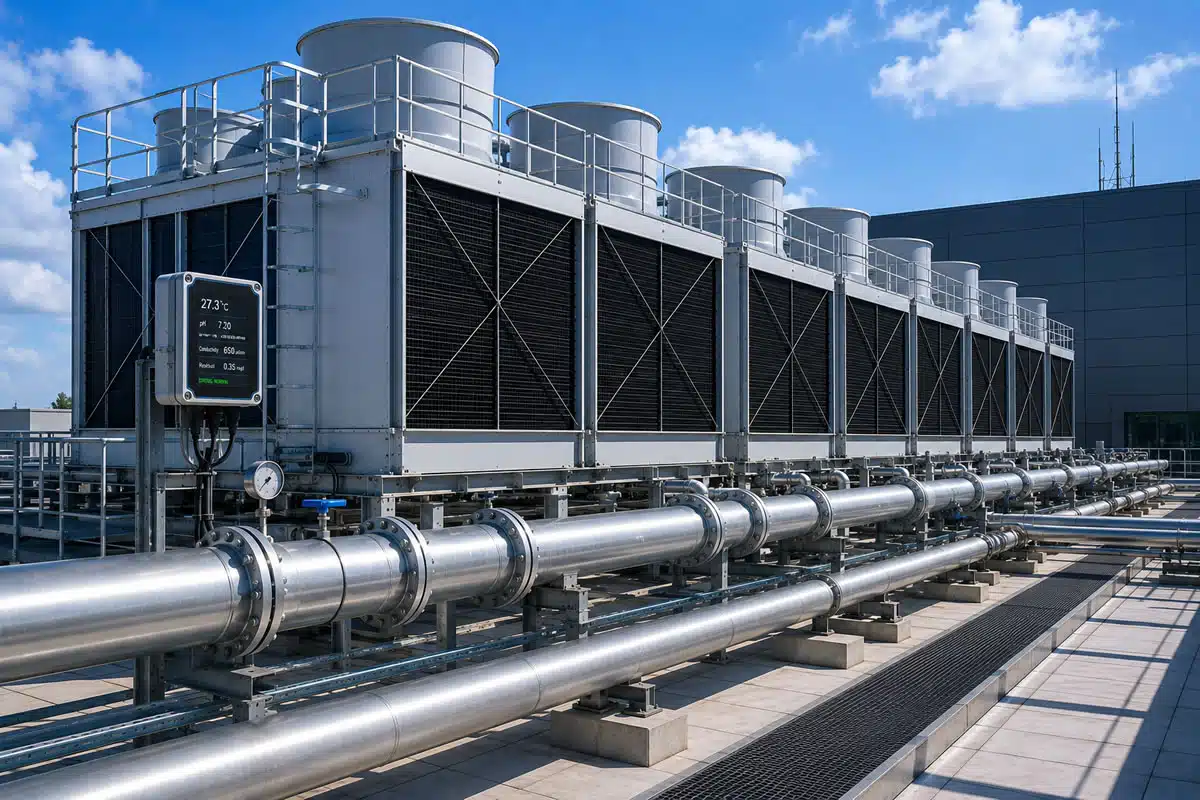
| Continuous water quality monitoring enables data centre operators to identify changing cooling water conditions early, helping to reduce Legionella risk and maintain efficient cooling tower performance.
Which buildings benefit most from continuous water monitoring?
Continuous water quality monitoring can benefit almost any building with a complex water system, but the biggest advantages are often where water safety is critical, systems are extensive, sites are geographically dispersed or water demand changes throughout the day.
Hospitals and healthcare
These rely on safe water to protect patients who may be more vulnerable to infection. Continuous monitoring provides an early warning of changing water conditions, helping estates teams respond quickly to support compliance with healthcare water safety.
Care homes
Care homes accommodate people who are more susceptible to Legionnaires’ disease. Real-time monitoring provides reassurance that water temperatures and other key parameters remain within acceptable limits between routine inspections.
Universities and educational campuses
They often have large, complex water systems serving multiple buildings with varying occupancy levels. Continuous monitoring helps identify changes caused by periods of low water usage during holidays and other seasonal fluctuations.
Hotels and leisure
Properties in this sector experience changing occupancy throughout the year and this can result in periods of reduced water use. Online monitoring allows facilities managers to identify potential issues before they affect guests or disrupt operations.
Large commercial estates
These can include multiple buildings, extensive pipework and numerous outlets spread across a wide site. Remote monitoring reduces the need for manual inspections while providing a clearer picture of water system performance.
Manufacturing facilities
These depend on reliable water systems for both operational processes and employee safety. Continuous monitoring can identify changes that could affect production, equipment performance, quality or compliance.
Data centres
Data centres require reliable cooling water systems to maintain critical infrastructure. Early detection of abnormal water conditions can help prevent equipment damage, reduce downtime, improve safety and support business continuity.
In each of these environments, continuous monitoring is not intended to replace routine inspections or laboratory testing. Instead, it provides continuous visibility of water system performance, allowing organisations to identify potential problems sooner and make better informed maintenance and water safety decisions.
Can IoT water sensors predict microbiological problems?
Yes. As we noted earlier, sensors can check for various changes in the water. These may include temperature, pH, and turbidity, all of which could make it easier for Legionella and similar waterborne bacteria to multiply.
By identifying criteria that could lead to an issue, the sensors can alert you to these problems at a very early stage. You can then take the required steps to stop those microbiological problems from ever developing – all thanks to real-time water analysis.
How continuous monitoring supports traditional laboratory testing
Traditional laboratory testing is still important. Online water quality analysis provides you with the data you need to identify potential issues earlier than you would with a manual analysis and testing system in place.
If you receive an alert of this nature, you can take representative water samples and send them for laboratory testing to determine what’s happening. These samples will identify whether you need to make any changes – for example, to adjust the disinfectant dosing system in place, or increase water temperatures.
However, early detection courtesy of IoT water sensors allows you to act before you receive the results from the lab. See it as an early warning system.
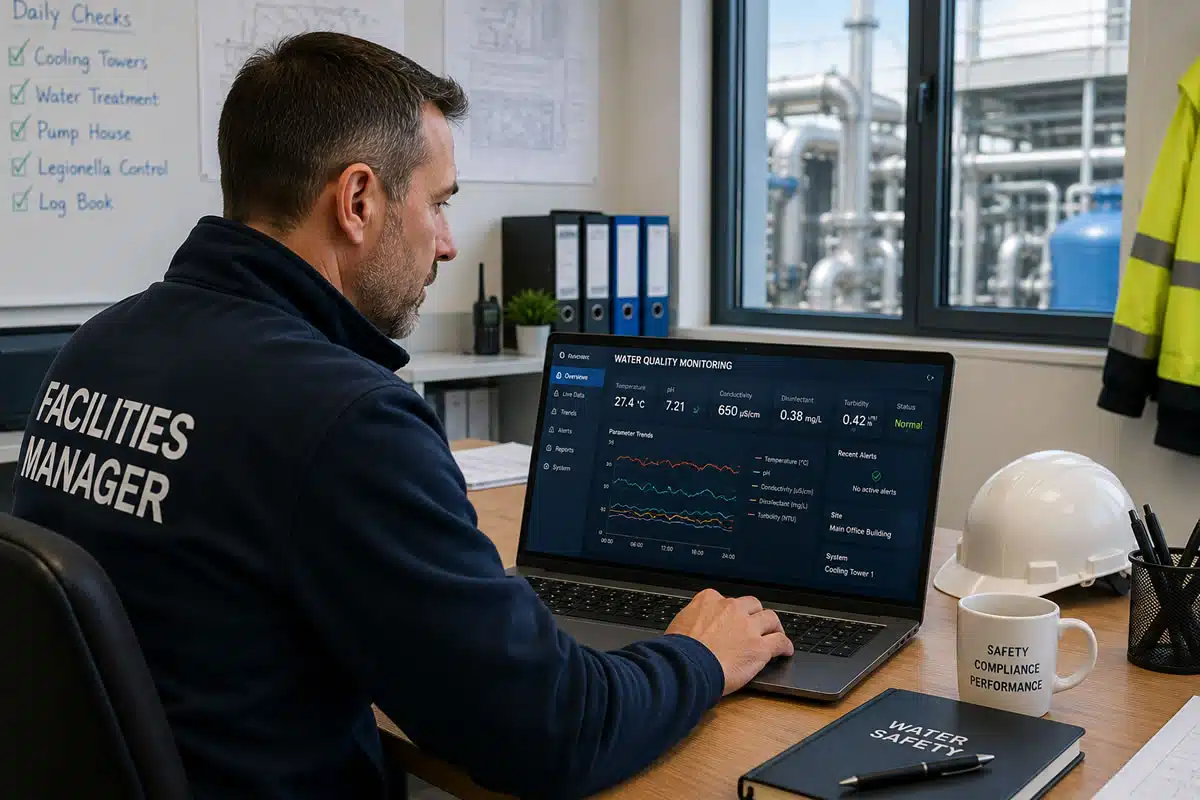
| Continuous water quality monitoring gives facilities managers instant access to live system data, helping them identify developing issues and make informed decisions before they become water safety or compliance problems.
Where is digital water safety heading?
Water quality monitoring still largely relies on manual checks and reactive actions if anomalies are found. As time goes on and AI models become more accurate, we may well see a rise of digital water monitoring as noted here.
This technological shift will see reactive monitoring changing to proactive and predictive monitoring. It will see a shift from resolving issues as they arise to preventing them when we receive data that suggests a problem could be about to occur.
As time goes on, we’re also likely to see a cost reduction for the necessary equipment used in digital water safety management. It will eventually become the gold standard in preventative measures to keep water systems of all kinds safe and effective.
Continuous monitoring is changing water safety—Not replacing good practice
Continuous water quality monitoring provides an ongoing stream of data for AI models to assess and compare to historical data. Switching from manual checks to a system of this nature requires experts to identify the best approach for each individual water system.
Our Legionella specialists can advise you on how you may benefit from introducing online water quality analysis. You’ll be able to rely on continuous monitoring, real-time data-driven alerts, and continual adherence to all necessary regulations for water safety.
If you’re considering continuous water quality monitoring as part of your Legionella control strategy, our specialists can assess your water systems, explain the technologies available and help you determine whether a digital monitoring solution is best for your buildings and level of risk.
